This article offers an in-depth guide to making a delicious Chaozhou fish ball, napa cabbage, and glass vermicelli claypot, while also sharing the method and techniques for Teochew-style fish balls—from assessing shrimp freshness and mastering the hand-beaten fish paste, to food safety, storage, and pairing suggestions—so the entire classic Chaoshan flavor profile can be confidently reproduced.
This article will show you:
Essence of Chaozhou fish balls
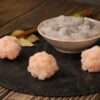
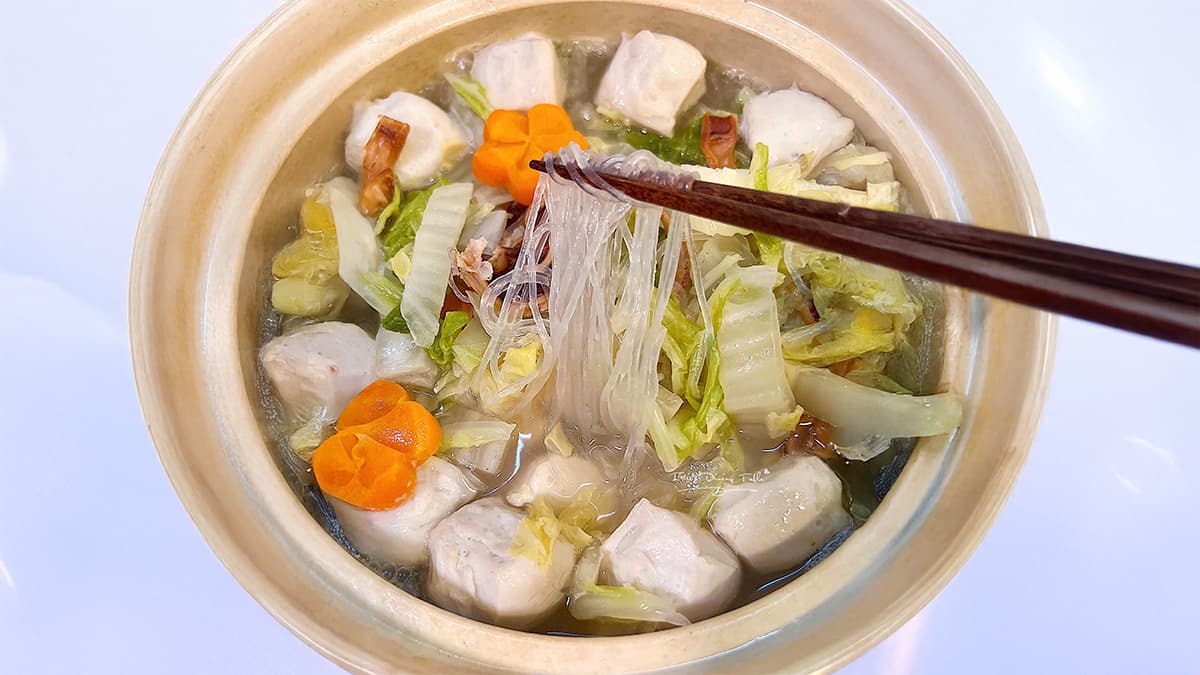
The hallmark of hand-beaten fish balls is their distinctive elasticity and natural sweetness. Chaozhou masters often say that fish balls must be “springy, savory, and crisp,” which depends not only on ingredient selection but also on the processing method. When Teochew fish balls are paired with crunchy Napa cabbage and broth-soaked glass vermicelli, the result is a warming claypot with bright, abundant flavors—the very essence of this Napa cabbage and vermicelli dish.
Choosing shrimp and freshness
In the Chaoshan region, fish balls aren’t made with fish alone; shrimp is often added to enhance umami. When selecting shrimp, note:
- Shells should be intact and translucent, with a natural sheen.
- Heads should be firmly attached to bodies, with no blackening.
- Aroma should be a faint briny scent of the sea, not fishy or sour.
Combining shrimp and fish enhances the protein content and yields a bouncier texture.
Craft of hand-beaten fish balls
Dryness and low temperature
Before making the paste, thoroughly dry the fish and shrimp to prevent excess moisture from weakening the bind.
Keep the mixture cold—nest mixing bowls over ice—so protein fibers stay intact for that crisp, springy texture.
Add-ins: keep it minimal
Traditional Teochew practice is “less but precise”:
- Primarily salt, a touch of sugar, white pepper, and starch (tapioca or potato).
- Salt “develops structure,” tightening the fish ball’s matrix.
- A little lard or peanut oil adds silkiness, but too much harms elasticity.
- Avoid excessive artificial additives to preserve the natural sweetness of seafood.
Salt-for-structure and mixing direction
Two keys to achieving “spring”:
- Add salt early in mixing to promote protein cross-linking quickly.
- Keep a consistent mixing direction; switching back and forth disrupts the protein network. Beat rapidly in one direction for 10–15 minutes until the paste turns tacky and stretchy.
Proportions and staged additions
A classic ratio for hand-beaten fish balls:
- 500 g fish
- 150 g shrimp
- 10 g salt
- 3 g sugar
- 30 g starch
- 50 ml ice water
Add the ingredients in stages: first, add the salt, then the sugar and starch, and finally stream in the ice water. This layered approach helps the paste absorb and bind step by step, resulting in complete elasticity.
Shaping and heat control
Shaping technique
Squeeze the paste through the crook of the thumb and forefinger to form balls, then scoop with a spoon—an old-school method. Keep sizes uniform for even heating.
Heat management
Use a gentle simmer at 80–85°C rather than a hard boil. Excess heat roughens surfaces and can cause them to split. Slow cooking preserves fullness and a smooth exterior.
Storage, thawing, and food safety
- Storage: Uncooked fish balls are best stored frozen at a temperature below −18°C for up to 1 month.
- Thawing: Defrost in the refrigerator; never use hot water, as this can loosen the structure.
- Safety: Avoid refreezing; discard if color dulls or odor turns off.
Serving extensions and nutrition pairing
With napa cabbage and glass vermicelli claypot
The broth is typically based on pork or chicken bones, with the addition of dried scallops or dried shrimp for an extra savory flavor. Vermicelli soaks up the broth and seafood sweetness, giving a layered texture, while Napa cabbage is crisp and gently sweet, cutting the richness and adding dietary fiber.
Nutrition pairing
- Fish balls and shrimp provide high-quality protein for muscle repair.
- Vermicelli supplies carbohydrates for energy.
- Napa cabbage adds fiber for digestion and overall balance.
- Goji berries or mushrooms can further support the immune system.
Conclusion
This Chaozhou claypot combines bouncy fish balls, sweet and crisp Napa cabbage, and broth-absorbing vermicelli for triple-texture satisfaction. Master the five principles—fresh selection, dryness and low temperature, salt for structure, single-direction mixing, and gentle heat for shaping—and this classic Chaoshan dish can be faithfully recreated at home.
Summary Table
Key Points | Key Tips |
Choose shrimp and fish | Freshness determines flavor and taste |
Dry water and low temperature | Protect protein fibers and maintain elasticity |
Additives | Less but better, avoid artificial flavoring |
Stirring method | Add salt at the beginning and stir in a fixed direction |
Recipe Layering | Add the seasoning layer by layer, ensuring it is combined |
Shaping technique | Squeeze with the tiger's mouth and put it in the pot on low heat |
Save and thaw | Frozen at -18°C, thawed naturally |
Nutrition pairing | Protein + fiber + energy, a balanced diet |
Frequently Asked Questions
Why are my fish balls not chewy enough?
This could be caused by inconsistent stirring directions or by the temperature being too high during operation, causing the protein to denature. It is recommended to keep the temperature low throughout the process and whip quickly in a fixed direction.
What happens if fish balls are overcooked?
Overcooking the fish balls or cooking them for too long will cause them to become dry and lose their moisture. Bring to a simmer and remove them when they float to the surface.
Can I omit the shrimp?
Of course, you can, but shrimp adds flavor and elasticity. If you don't add shrimp, you can adjust the fish-to-meat ratio and add a small amount of starch to maintain the texture.